Polymerase Chain Reaction (PCR) is a cornerstone in molecular biology and biotechnology, enabling the exponential amplification of DNA fragments for research, cloning, and gene expression studies. Among its numerous variations, Hot Start PCR represents one of the most powerful refinements for enhancing specificity and reproducibility.
In the specialized formulation Hot Start – With Buffer – With MgCl₂ – Without dNTP, the system is designed for maximum experimental control, providing the enzyme, optimized ionic buffer, and magnesium ions, but excluding dNTPs (deoxynucleotide triphosphates). This setup empowers researchers to adjust nucleotide concentration, incorporate modified nucleotides, or time their addition precisely to minimize non-specific extension events.
Hot Start PCR prevents premature DNA synthesis during reaction setup at room temperature. DNA polymerases, particularly Taq polymerase, can extend mis-annealed primers or form primer-dimers even at moderate temperatures, leading to non-specific amplification. To address this, Hot Start polymerases are temporarily inactivated—through chemical modification, antibody binding, or aptamer inhibition—until the initial high-temperature activation step (usually 94–95 °C).
More on Hot Start mechanisms can be found at New England Biolabs (NEB) and NCBI’s resources on PCR efficiency.
This activation ensures that DNA polymerase remains inactive during the preparation stage, minimizing artefacts and improving amplification accuracy.
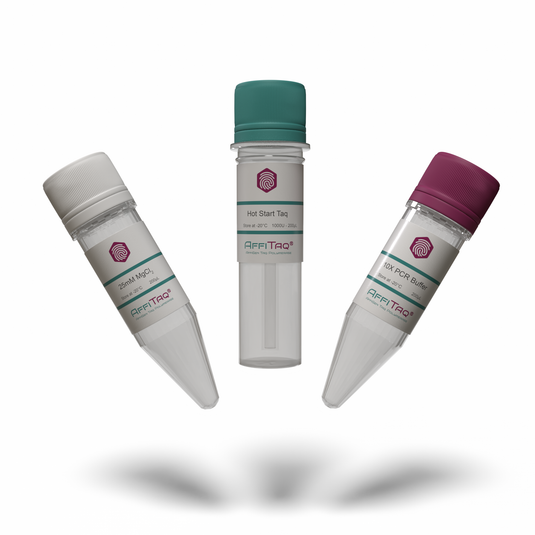
PCR buffers provide a stable environment that maintains enzyme activity, pH balance, and ionic strength throughout the amplification cycles. A typical buffer contains:
Tris-HCl (pH 8.3–8.8) for pH stability
KCl or (NH₄)₂SO₄ for ionic strength
Stabilizers such as gelatin, BSA, or detergents
MgCl₂, either pre-included or added separately
The U.S. National Library of Medicine’s PubChem Database provides chemical insights into the role of magnesium chloride and its coordination chemistry.
A properly formulated buffer ensures consistent annealing temperatures, optimal polymerase conformation, and reproducible amplification performance. The absence of dNTPs in this formulation prevents premature complexation between dNTPs and Mg²⁺, allowing independent titration of both components.
Magnesium ions are critical cofactors that coordinate with both dNTPs and the DNA template. Mg²⁺ binds to the phosphate groups of dNTPs and stabilizes the transition state during the phosphodiester bond formation process.
The concentration of MgCl₂ affects multiple reaction parameters:
Low Mg²⁺ (< 1 mM) results in insufficient enzyme activity
Optimal Mg²⁺ (1.5–2.5 mM) balances specificity and yield
High Mg²⁺ (> 4 mM) often leads to mis-priming and non-specific bands
Detailed mechanistic analyses are discussed in open resources from Stanford University, University of California, Berkeley, and NCBI Bookshelf.
In a Hot Start – With Buffer – With MgCl₂ – Without dNTP system, magnesium is typically pre-optimized for the polymerase formulation but can be fine-tuned by supplementing additional MgCl₂ from a 25 mM stock solution.
In most commercial PCR kits, dNTPs are premixed with buffer and MgCl₂. However, omitting dNTPs offers several advantages for advanced research workflows:
Enables independent control over each dNTP concentration (useful in mutagenesis)
Permits late addition of dNTPs for manual hot-start procedures
Allows incorporation of modified nucleotides, such as fluorescently labelled or deoxyuridine analogues
Reduces the potential for Mg²⁺ chelation imbalance before thermal activation
An in-depth discussion on the impact of dNTP concentration on reaction kinetics is available via the US National Institutes of Health (NIH) and National Center for Biotechnology Information (NCBI).
A detailed reaction setup for 50 µL Hot Start PCR (with buffer and MgCl₂, without dNTP) is outlined below:
| Component | Stock Concentration | Final Concentration | Volume (µL) |
|---|---|---|---|
| 10× Hot Start PCR Buffer | 10× | 1× | 5.0 |
| MgCl₂ (25 mM) | — | 1.5–2.5 mM | 2.0 |
| Forward Primer (10 µM) | — | 0.2 µM | 1.0 |
| Reverse Primer (10 µM) | — | 0.2 µM | 1.0 |
| Hot Start DNA Polymerase | 5 U/µL | 1.25 U | 0.25 |
| Template DNA | variable | — | 1–2 |
| Nuclease-free water | — | — | up to 50 µL total |
| dNTPs | — | add separately | — |
Thermal cycling profile:
Initial Activation: 95 °C, 3–5 min
30–40 cycles of:
Denaturation: 94 °C, 30 s
Annealing: 55–65 °C, 30 s
Extension: 72 °C, 1 min per kb
Final Extension: 72 °C, 5 min
Hold: 4 °C
More reference cycling conditions can be found in the University of Arizona PCR protocol and MIT OpenCourseWare laboratory notes.

Because Mg²⁺ chelates dNTPs, every increase in dNTP concentration effectively reduces free Mg²⁺. The stoichiometry between Mg²⁺ and total dNTPs must be carefully balanced to maintain catalytic activity. The U.S. National Library of Medicine provides a comprehensive guide on Mg²⁺–nucleotide binding constants.
Buffers typically employ Tris-HCl (pH 8.3–8.8 at 25 °C). The stability of pH across thermal cycling is crucial; even small shifts can influence polymerase conformation. For deeper analysis of Tris buffering systems, refer to University of Wisconsin-Madison Biochemistry Lab Protocols.
Primers must avoid secondary structures and complementarity. The USDA Agricultural Research Service (ARS) provides excellent general recommendations.
| Type | Mechanism | Temperature Range | Notes |
|---|---|---|---|
| Antibody-blocked polymerase | Antibody binds the active site, released at 95 °C | 90–95 °C | Stable, highly specific |
| Aptamer-inhibited polymerase | Short oligo binds polymerase reversibly | 60–70 °C | Fast activation |
| Chemical modification | Covalent bond cleaved during heating | 90–95 °C | Common in early kits |
| Manual hot start | Enzyme or dNTPs added after denaturation | — | Requires manual handling |
For examples, see resources from Cornell University’s Molecular Biology Core and US National Library of Medicine archives.
| Observation | Likely Cause | Solution |
|---|---|---|
| No amplification | dNTPs not added, Mg²⁺ too low | Verify addition of dNTPs, raise MgCl₂ by 0.5 mM |
| Multiple non-specific bands | Excess Mg²⁺ or low annealing temperature | Decrease MgCl₂, increase annealing temp |
| Smear on gel | Too much template DNA or Mg²⁺ | Dilute DNA, titrate MgCl₂ |
| Weak yield | Enzyme activity loss | Extend activation, ensure fresh buffer |
| Primer-dimers | High primer concentration | Reduce primer conc. or redesign primers |
The University of Michigan DNA Sequencing Core provides visual troubleshooting guides with electrophoresis examples.
Cloning and site-directed mutagenesis – Enables manipulation of dNTP ratios for controlled mutation rates.
Long-range PCR – Allows delayed addition of dNTPs to enhance initial template denaturation.
High-fidelity amplification – Used in enzyme systems with proofreading polymerases requiring separate nucleotide control.
Modified base incorporation – Ideal for fluorescent or biotinylated dNTPs (references: Oregon State University protocols).
Gradient optimization studies – Enables multi-parameter screening of Mg²⁺/dNTP ratios simultaneously.
Chelation Control: When dNTPs are absent, Mg²⁺ remains unchelated, increasing free ionic strength. Adjust Mg²⁺ concentration downward after dNTP addition.
Enzyme Stabilization: Certain hot-start polymerases contain proprietary stabilizers (e.g., trehalose, glycerol, detergents) within the buffer system.
Thermal Profile Sensitivity: Extended pre-activation times (> 10 min) can denature the antibody inhibitors in some formulations, as reported by US National Center for Biotechnology Information.
Although this product configuration is strictly for research use only, it should be handled under standard molecular biology laboratory conditions. Avoid contamination by using filtered tips, maintaining cold reagents, and performing reaction setup in a laminar flow hood. Additional safe laboratory practices are documented by the Occupational Safety and Health Administration (OSHA) and Centers for Disease Control and Prevention (CDC).
The Hot Start – With Buffer – With MgCl₂ – Without dNTP formulation delivers exceptional flexibility and control in PCR system design. Its modular nature enables users to customize nucleotide concentration, maintain optimal magnesium ion balance, and ensure high-specificity amplification.
Key highlights:
Prevents non-specific extension during setup
Allows precise control over Mg²⁺ and dNTP ratios
Supports specialized workflows with modified nucleotides
Ensures enzyme stability under thermal cycling conditions
Extensive technical background can be found at:
